Ivan the Terrible by Charles J. Halperin
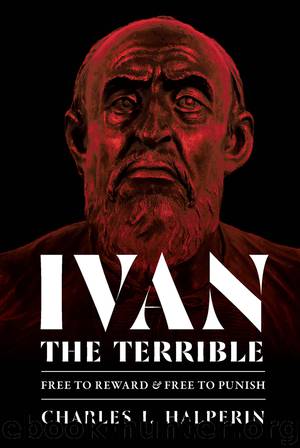
Author:Charles J. Halperin
Language: eng
Format: epub
ISBN: 9780822987222
Publisher: University of Pittsburgh Press
16
Ivan’s Ideology, the Oprichnina, and Muscovite Society
A viable interpretation of the oprichnina should take into account two fundamental but separate factors: Ivan’s intentions in creating it, and how Muscovite society responded to his actions. The evolution of the oprichnina resulted from the interaction of Ivan and society. He felt morally and intellectually (but not physically) overburdened by the multiple layers of Muscovite ruler-myth ideology. He could not resolve the contradiction between his personal wish to be pious and the demands of his office, which required him to act impiously, so he pretended to abdicate, knowing that he could not or would not actually renounce power. In this sense Ivan programmed the oprichnina to fail. He had staged a spectacle, not perpetrated a coup d’état. He could not seize power because he already had power.
Because Ivan did not abdicate, his personal act had political consequences. Ivan created an autonomous zone that he tried, but failed, to isolate from society. The residential and social isolation of the oprichniki from non-oprichniki reflected Ivan’s desire to divorce himself from the rest of Muscovite society. Politically, Ivan’s actions in establishing the oprichnina institution—such as deporting population—created political opposition. The spontaneous lawlessness of the oprichniki exacerbated that opposition. When fighting that opposition elevated repression from a secondary by-product of the oprichnina to its primary function, Ivan turned to mass terror. Mass terror, in turn, fed upon the long-repressed strains on Muscovite society resulting from a century of directed change in the form of social mobilization and social engineering—integration of the boyars and the creation of the gentry and the bureaucracy. This combination of terror and social malaise proved explosive. Mass terror drew its dynamism from Muscovite social disorder, and it followed its own inexorable logic to self-destruction. The elite used the oprichnina to settle intra-class feuds. Mass terror produced the massacres of the northwest campaign and the horrors of the Moscow mass executions. The antisocial behavior of the oprichniki inflicted huge harm upon Muscovite society and forced Ivan to terrorize the oprichniki. Everybody in Muscovy lost, including Ivan. The interaction between Ivan’s intentions and actions, and between Muscovite society’s reactions and social problems, determined the evolution of the oprichnina.
This chapter elucidates the Muscovite ruler cult that animated and confounded Ivan until he sought respite off the throne. Then it will analyze the evolution of Muscovite society, which generated the destructive energy unleashed by the oprichnina.
THE OPRICHNINA AS IDEOLOGICAL OVERLOAD
Michael Cherniavsky interpreted Ivan’s actions as the product of the accumulation of ideological burdens on the Muscovite ruler. Ivan’s political ideology consisted of three layers of myths, the first two of which consisted of two images in tension: Mongol khan and Byzantine basileus, saintly prince and pious tsar, and Renaissance prince.
The first layer comprised the tension between the ruler as Mongol khan, a secular image rooted in conquest, and the ruler as Byzantine basileus, a religious image rooted in Orthodox Christianity. The unresolved conflict between the two images manifested itself tragically in Ivan’s “killing by day and praying by night.
Download
This site does not store any files on its server. We only index and link to content provided by other sites. Please contact the content providers to delete copyright contents if any and email us, we'll remove relevant links or contents immediately.
| Africa | Asia |
| Canadian | Europe |
| Holocaust | Latin America |
| Middle East | United States |
Fanny Burney by Claire Harman(26660)
Empire of the Sikhs by Patwant Singh(23135)
Out of India by Michael Foss(16985)
Leonardo da Vinci by Walter Isaacson(13411)
Small Great Things by Jodi Picoult(7222)
The Six Wives Of Henry VIII (WOMEN IN HISTORY) by Fraser Antonia(5557)
The Wind in My Hair by Masih Alinejad(5137)
A Higher Loyalty: Truth, Lies, and Leadership by James Comey(5017)
The Crown by Robert Lacey(4862)
The Lonely City by Olivia Laing(4841)
Millionaire: The Philanderer, Gambler, and Duelist Who Invented Modern Finance by Janet Gleeson(4538)
The Iron Duke by The Iron Duke(4404)
Papillon (English) by Henri Charrière(4322)
Sticky Fingers by Joe Hagan(4253)
Joan of Arc by Mary Gordon(4156)
Alive: The Story of the Andes Survivors by Piers Paul Read(4077)
Stalin by Stephen Kotkin(4003)
Aleister Crowley: The Biography by Tobias Churton(3671)
Ants Among Elephants by Sujatha Gidla(3494)
